

Rubber and TPE mats win on protection; carpet wins on comfort and looks. If your winters bring salt and slush or you haul kids, gear, or pets daily, all-weather liners are the better call. If your driving stays mostly dry and you care about a plush, factory-fresh cabin, carpet still earns its keep. Many owners split the difference with a seasonal swap, and a custom-fit liner set covers the protection side without sacrificing fit.
TL;DR:
- All-weather liners made from TPE or rubber are best for cold, wet, or muddy conditions, offering longer lifespan and better protection against salt and slush.
- Fit and retention are crucial for safety and durability, with vehicle-specific liners preventing shifting and pedal interference more effectively than universal mats.
- Carpet mats suit dry climates and owners prioritizing comfort, but they tend to wear out faster and can develop odors from trapped moisture.
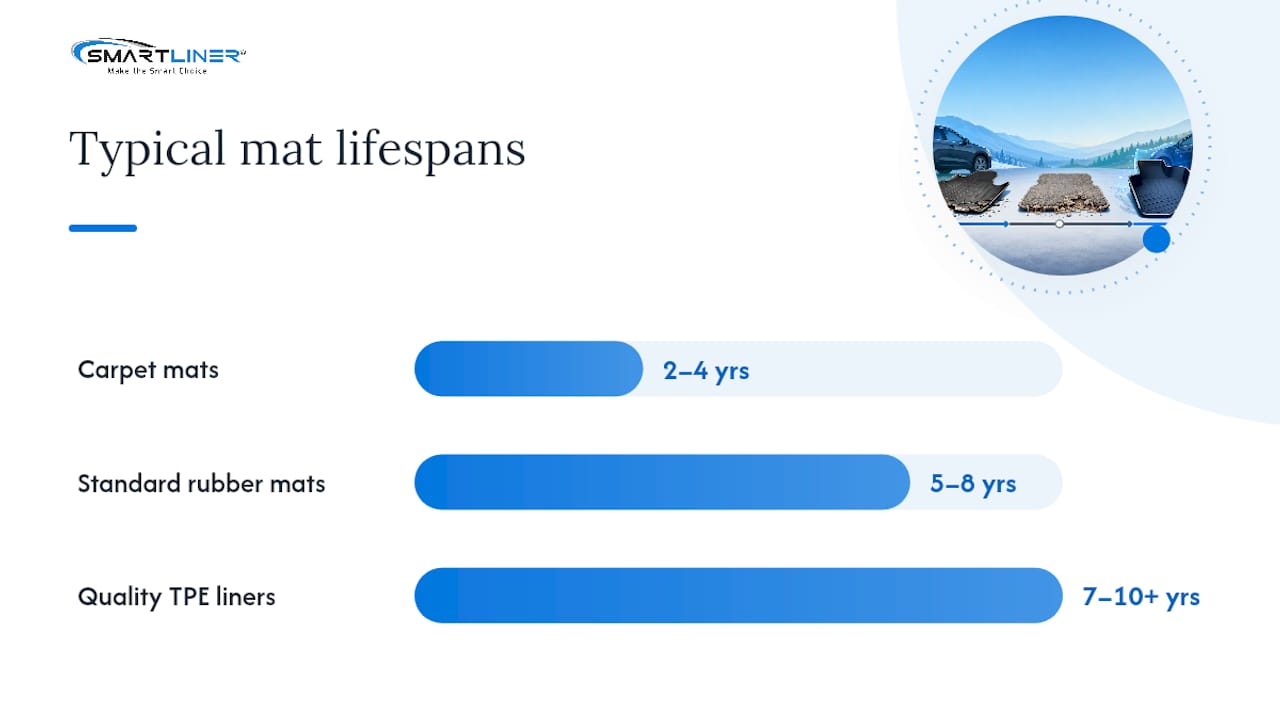
- Expect rubber mats to last five to eight years and TPE liners up to ten years or more, with lifespan heavily influenced by proper fit and usage conditions.
- Regular cleaning routines require vacuuming and spot treatment for carpet, hose and scrub for rubber, and simple rinsing for TPE liners to prevent odors and staining.
Table of Contents
- Carpet vs. Rubber Mats at a Glance
- Carpet, Rubber, and TPE: What Each Material Actually Does
- How Long Do Carpet and Rubber Mats Actually Last?
- How to Clean and Maintain Each Mat Type
- Does Mat Fit Affect Safety, Not Just Comfort?
- Choosing Between Carpet and Rubber: A Practical Checklist
- Why Custom-Fit Liners Solve the Protection Problem Directly
- What Actually Matters When You’re Choosing Mats
- Ready to Match Your Vehicle to the Right Liner
- Sources
- FAQ
Carpet vs. Rubber Mats at a Glance
The decision usually comes down to five practical factors, and none of them favor one material across the board.
- Containment and water resistance: Rubber and TPE liners trap standing water, mud, and slush in raised channels; carpet absorbs it straight into the fibers.
- Comfort, noise, and presentation: Carpet feels softer underfoot and dampens road noise better, which is why it still ships standard in most new vehicles.
- Cleaning speed: A hose and a towel handle rubber or TPE in minutes; carpet often needs a vacuum pass, spot treatment, and time to dry.
- Cold-weather behavior: Standard rubber can stiffen and crack in freezing temperatures, while TPE stays flexible down to temperatures around freezing.
- Lifespan and cost: Carpet mats run cheapest up front but wear out fastest; rubber and TPE liners cost more initially and last considerably longer.
None of these factors work in isolation. A rubber mat that traps water beautifully but slides around under your feet is a safety problem, not a win. That’s why fit and retention matter as much as the material itself, a point worth returning to before you buy anything.
Carpet, Rubber, and TPE: What Each Material Actually Does
Carpet mats are built from woven or looped fiber bonded to a thin backing, and that construction is exactly why they struggle with moisture. The fibers soak up spilled coffee, melted snow, and tracked-in mud, then hold onto it. That trapped moisture is the main reason carpet mats develop musty odors and, in bad cases, mildew along the backing.
Rubber mats solve the absorption problem but introduce a different one. Standard rubber relies on petroleum-based processing oils that can make the material stiffen in cold weather and, over time, give off a faint chemical smell. On the plus side, rubber wipes and hoses clean far faster than carpet ever will.
TPE, short for thermoplastic elastomer, splits the difference. It’s a hybrid polymer that behaves like rubber for water and stain resistance but skips most of the odor and cold-stiffening issues. TPE resists petroleum off-gassing and holds up longer than standard rubber, which is why more manufacturers use it in premium all-weather liners.
Here’s how those material properties play out in real driving:
- Carpet in a garage-kept sedan driven mostly on dry roads: minimal issue, since there’s little moisture to absorb.
- Rubber in a work truck used year-round in a cold climate: reliable protection, with some winter stiffness to expect.
- TPE in a family SUV that sees rain, snow, and daily school runs: the most consistent performer across seasons.
How Long Do Carpet and Rubber Mats Actually Last?
Expect roughly two to four years from carpet mats under regular use before curling edges, flattened pile, or set-in stains make replacement worthwhile. Standard rubber mats typically run five to eight years. Quality TPE liners often reach seven to ten years or more, according to material lifespan comparisons in the automotive aftermarket.
Fit changes those numbers more than most buyers expect. A universal mat that shifts and bunches wears out fast because it’s absorbing stress at the wrong points. A vehicle-specific liner sits flush against the factory floor pan and distributes wear evenly, which is a big part of why laser-measured, custom-fit liners hold up longer than generic mats.
Watch for three warning signs regardless of material: curling or cracking at the edges, a odor that persists after cleaning, and visible thinning where your heel rests. Any one of those means the mat has stopped doing its job, even if it still looks fine from a few feet away.
How to Clean and Maintain Each Mat Type
Carpet, rubber, and TPE each need a different care routine, and skipping the right one is how odors and stains take hold.
- Carpet: Vacuum weekly, spot-treat spills immediately with a mild upholstery cleaner, and run a deep extraction every few months if you drive in wet conditions. Always let carpet dry fully before reinstalling it, since trapped moisture is what causes mildew.
- Rubber: Pull the mats out, hose them down, scrub with a soft brush and mild detergent, then air-dry completely before putting them back. Skipping the drying step just reintroduces the moisture problem rubber is supposed to solve.
- TPE and all-weather liners: A quick hose-off and wipe-dry is usually enough, since the non-porous surface doesn’t hold onto grime the way carpet does.
If you’re rotating between two sets seasonally, store the unused pair somewhere dry and flat rather than rolled up, which prevents permanent creasing.
Pro Tip: Keep a second set of liners in the trunk during unpredictable weather months. Swapping wet-weather liners for your dry-condition mats takes under a minute and saves your carpet from a full season of salt exposure.
Does Mat Fit Affect Safety, Not Just Comfort?
Fit is a safety issue before it’s a comfort issue. A mat that’s even slightly too large can ride up under the brake or accelerator pedal, and pedal interference is one of the more common causes of unintended acceleration complaints tied to floor mats. Before trusting any mat, press the brake pedal fully to the floor and confirm nothing bunches or shifts near it.
Retention hooks matter just as much. Mats without proper anti-slip backing or retention points can slide out of place, which defeats the purpose of buying protection in the first place. Vehicle-specific liners use factory-matched retention posts that hold the mat exactly where the floor pan places them.
For winter containment, look for a raised perimeter edge and interior channel depth of at least half an inch to three-quarters of an inch. That’s enough to hold melted slush and road salt above the carpet line instead of letting it seep through at the edges.
Choosing Between Carpet and Rubber: A Practical Checklist
Run through these questions before you buy, since the right answer changes based on how and where you actually drive.
- Does your area see regular snow, rain, or road salt for more than a few months a year?
- Do you carpool kids, transport pets, or haul gear that tracks in dirt?
- Is this a daily driver or a vehicle you keep mostly for weekend use and resale value?
- Do you care more about a soft, quiet cabin or about never worrying about a spill?
If your answers lean toward messy climates or frequent use, all-weather liners are the stronger investment. Carpet still makes sense for dry-climate drivers or anyone prioritizing showroom presentation. Plenty of owners keep both and swap seasonally, using carpet for dry months and rubber or TPE liners once the weather turns.
Budget-wise, expect basic universal carpet mats to start under $50, while custom-fit all-weather liner sets typically run somewhere in the $100 to $250 range depending on vehicle size and coverage. That upfront gap narrows fast once you factor in how much longer a quality liner lasts. All-weather liners also help protect resale value by keeping factory carpet free of the stains and salt damage that hurt trade-in appraisals.
For winter driving specifically, taking steps to limit road salt exposure alongside a proper liner setup does more for your interior’s long-term condition than either measure alone.
Why Custom-Fit Liners Solve the Protection Problem Directly
Some liners are built around precise-fit technology, meaning each set is designed to match a specific vehicle’s floor pan rather than approximate it. That precision is what closes the gaps universal mats leave at seat rails and around the dead pedal, gaps that let water and grit reach the factory carpet underneath.
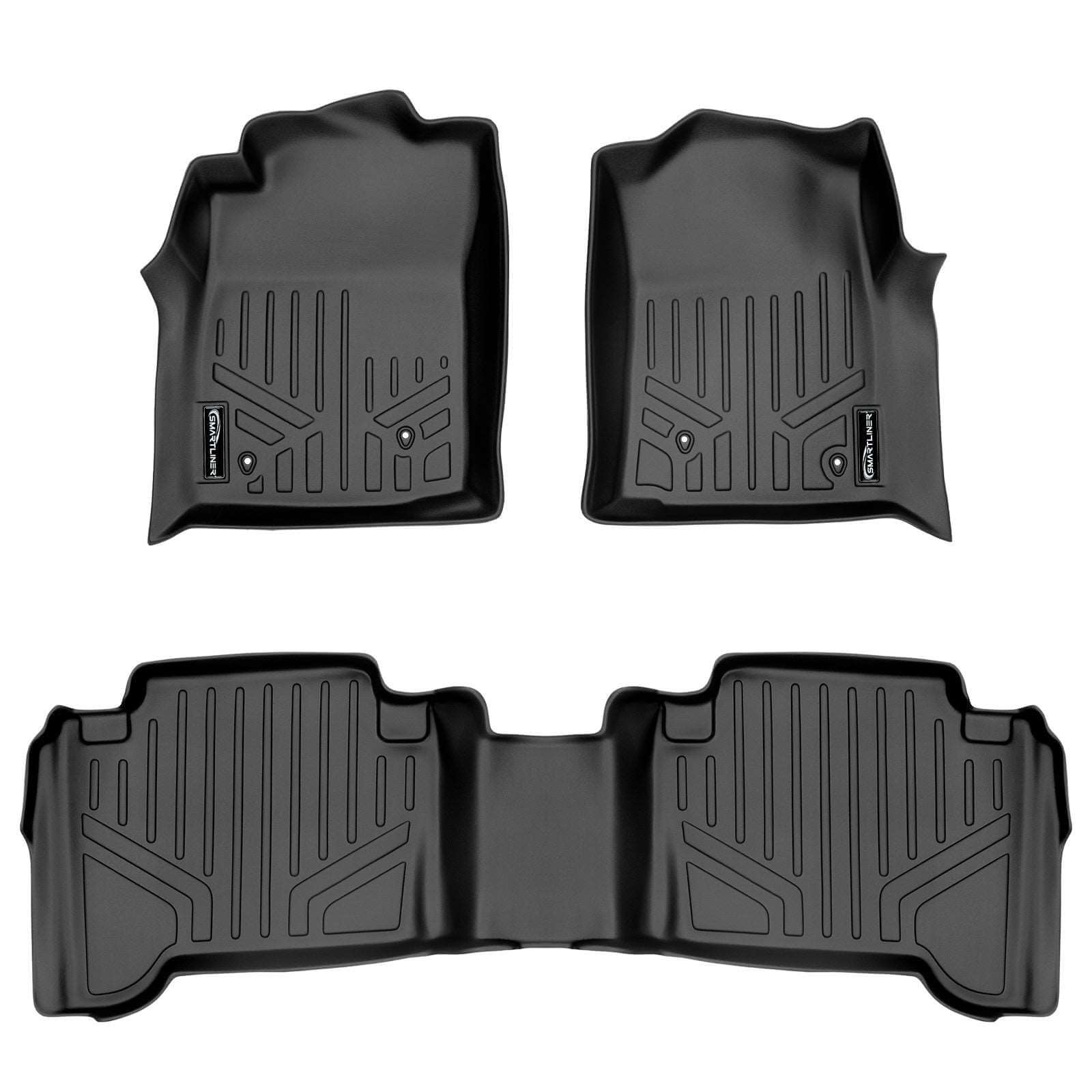
The materials matter too. Smartliner-usa liners use eco-friendly, 100% recyclable materials that hold up to repeated exposure without the stiffening or odor problems that plague cheaper rubber.
A few scenarios where this fit-first approach earns its cost:
- A family hauling kids and pets through slush-covered school pickup lines needs edge-to-edge coverage, not a mat that shifts every time a door opens.
- Winter drivers dealing with salted roads need raised channels deep enough to hold runoff until it can be dumped out, not absorbed.
- Outdoor enthusiasts loading muddy gear into cargo areas need a liner, not carpet, in the trunk as much as the footwells.
For any of these situations, the fit and material combination is doing real work every time you get in the vehicle.
What Actually Matters When You’re Choosing Mats
Most buying guides treat this as a straight material comparison, and that’s where they miss the point. The real variable isn’t carpet versus rubber. It’s whether the mat actually fits your specific vehicle and matches how you actually use it.
I’d argue the seasonal swap gets recommended far more often than it gets followed through on. Buying two sets and rotating them sounds simple, but most owners buy one set, use it year round, and wonder why it wears out faster than expected. If you’re going to commit to carpet for its comfort and looks, commit to storing a liner set for the months you actually need protection, and vice versa.
The other underrated factor is retention. Buyers obsess over material choice and barely check whether a mat has proper anti-slip backing or model-matched hooks. A mediocre material that stays perfectly in place beats a premium material that slides toward the pedals. Check fit and retention first, then worry about carpet versus rubber.
— Marty
Ready to Match Your Vehicle to the Right Liner
Once you know whether you need protection or presentation, the next step is confirming your exact model and year. Smartliner-usa’s floor liner catalog covers vehicle-specific fits so you’re not guessing at coverage or retention points, and the cargo liner lineup extends that same protection into the trunk or hatch area. Truck owners hauling gear should check the truck bed mat liners, and off-road riders can find matching coverage in the UTV floor mats line.
Before ordering, verify your exact model, year, and trim, since retention post placement and floor pan shape vary even within the same vehicle generation. Check the product listing for return and warranty details specific to your set. If you drive something less common, browse the full Smartliner-usa catalog to find your match before settling for a universal fit.
Sources
- TPE vs Rubber vs Carpet Car Floor Mats
- How All-Weather Mats Protect Resale Value
- Are All-Weather Floor Mats Worth It for 2026 SUVs?
FAQ
What are the downsides of rubber flooring?
Standard rubber can stiffen and crack in cold temperatures and sometimes gives off a faint petroleum odor when new, though TPE largely avoids both issues.
What is the best material for floor mats?
It depends on your climate and habits: TPE or rubber all-weather liners handle moisture and mess better, while carpet offers more comfort and quieter cabins in dry conditions.
Are carpeted floor mats worth it?
Carpet mats are worth it for dry-climate drivers who prioritize comfort and appearance, but they fall short in wet or messy conditions where absorption leads to odor and staining.
What is better than WeatherTech floor mats?
Rather than comparing brands, focus on fit quality and retention. Custom-fit liners like those from Smartliner-usa use precise-fit technology and eco-friendly recyclable materials to match your specific vehicle’s floor pan.